
Histoplasmosis: Making a Difference in Primary and Emergency Medicine/Urgent Care

Why Care About Histoplasmosis?

  • Histoplasmosis can present as community-acquired pneumonia (CAP) that is difficult to distinguish from viral or bacterial CAP.
  • The diagnosis is frequently missed. On average, the diagnosis of histoplasmosis is delayed approximately 40 days. Many patients experience 4 missed diagnostic opportunities before being diagnosed.
  • In immunocompromised individuals or without appropriate treatment, histoplasmosis can cause severe disease or disseminated infection, which may be life-threatening. Approximately 5-7% of people hospitalized for histoplasmosis will die from the infection.
  • A recent study conducted in a Medicare population found that the histoplasmosis rate exceeded 100 cases/100 000 person years in 1806 US counties. Given the acceptability of testing for Legionnaire’s disease (approximately 2 cases/100 000 person years) and pulmonary embolism (approximately 112 cases/100 000 person years), appropriate testing for histoplasmosis makes sense in affected regions.

What Is It?

  • Histoplasmosis is a fungal infection caused by Histoplasma capsulatum, which is soil-based.
  • Histoplasmosis is associated with certain activities that involve plant matter, disturbing soil, or exposure to bird or bat droppings.
  • Most cases are asymptomatic or mild, but severe illness can occur, especially in people with weakened immune systems.

Where Does It Occur?

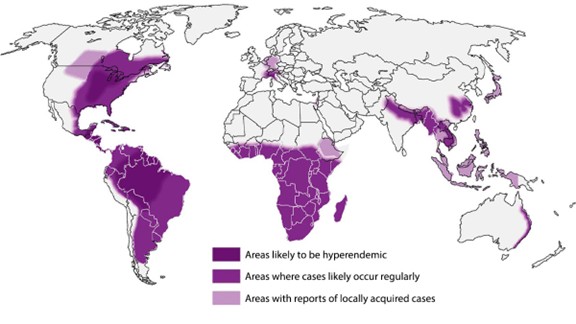
  • Histoplasma lives in the environment, particularly in the Central and Eastern United States and Central Canada, predominantly in areas around the Ohio and Mississippi River Valleys and the Great Lakes region; Puerto Rico; Latin America; Central Africa; and Southeast Asia. It is also found in parts of Europe and Australia. Histoplasma distribution is likely nationwide.
  • The regions affected by Histoplasma are shown in the 2 maps.
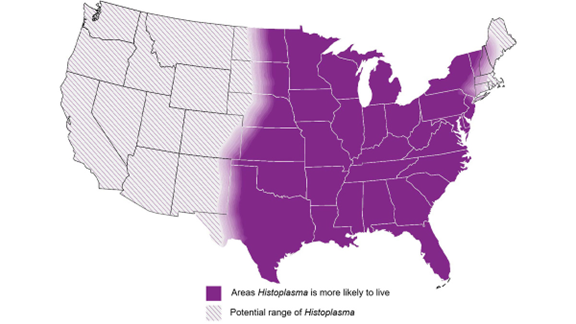
Approximate range of Histoplasma in the United States. Courtesy of CDC.

Approximate range of Histoplasma in the world. Courtesy of CDC.


Outbreak potential: Histoplasmosis has caused outbreaks among construction workers, spelunkers, and bridge inspectors. A 2025 cave-associated histoplasmosis outbreak was reported among travelers who returned to the United States after a trip to Costa Rico.

When Should I Test?

Consider testing for histoplasmosis in a patient with CAP who has lived in or traveled to an endemic area (see map) AND

  • The CAP is of unknown etiology and has not responded to at least one course of empiric antibiotics OR
  • The patient has had notable exposure to bird or bat droppings (cave or demolition/remodeling exposure; note that many patients do not recall a specific exposure) OR
  • Chest X-rays showing new nodules or lymphadenopathy OR
  • The patient is linked to a known histoplasmosis outbreak.

Clinical Pearl:

Many cases of histoplasmosis occur with no known exposure. However, since histoplasmosis can be associated with exposure to plant material or bat or bird droppings, it is helpful to query about hobbies and occupational exposures such as farming, gardening, cleaning out bird cages, or visiting caves (spelunking).

How Can I Diagnose It?

CHECK OUT…

PCP/Emergency Medicine Physicians Making a Difference in Histoplasmosis

Hear from Jessica Pelletier, DO, MHPE, FAAEM, an emergency medicine physician in Saint Louis, about her experience in caring for patients with histoplasmosis.

Click Here to Download a PDF Transcript of the Video


Patient Experience With Histoplasmosis

Listen to Carrea’s story and John’s story about the long road to a histoplasmosis diagnosis and the challenges associated with living with the disease.

Faces of Fungal Infection Videos – Fungus Education Hub

https://fightfungus.org/patient-videos-histoplasmosis/

Need Help? Get a Clinical Consult!

Healthcare providers can call 404-639-5168 or email fungalconsult@cdc.gov for consultation on diagnosis or treatment for suspected or confirmed fungal diseases.

RESOURCES

  • Centers for Disease Control and Prevention. Facts and stats about histoplasmosis. Histoplasmosis. April 24, 2024. Accessed July 28, 2025. https://www.cdc.gov/fungal/diseases/histoplasmosis/statistics.html
  • Centers for Disease Control and Prevention. Histoplasmosis. Accessed July 28, 2025. https://www.cdc.gov/histoplasmosis/index.html
  • Mazi PB, Sahrmann JM, Olsen MA, et al. The geographic distribution of dimorphic mycoses in the United States for the modern era. Clin Infect Dis. 2023;76(7):1295-1301. doi:10.1093/cid/ciac882
  • Miller AC, Arakkal AT, Koeneman SH, et al. Frequency and duration of, and risk factors for, diagnostic delays associated with histoplasmosis. J Fungi (Basel). 2022;8(5):438. doi:10.3390/jof8050438
  • Smith DJ, Free RJ, Thompson GR 3rd, et al. Clinical testing guidance for coccidioidomycosis, histoplasmosis, and blastomycosis in patients with community-acquired pneumonia for primary and urgent care providers. Clin Infect Dis. 2024;78(6):1559-1563. doi:10.1093/cid/ciad619

This educational initiative was funded in part by a cooperative agreement with the Centers for Disease Control and Prevention (CDC-RFA-CK20-2003) to the University of Alabama at Birmingham. The University of Alabama at Birmingham is collaborating with the Mycoses Study Group Education & Research Consortium and Terranova Medica, LLC, on this initiative. The Centers for Disease Control and Prevention is an agency within the Department of Health and Human Services (HHS). The contents of this resource center do not necessarily represent the policy of the CDC or HHS and should not be considered an endorsement by the Federal Government.