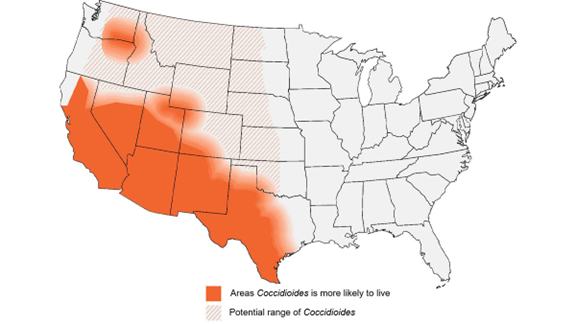
 Outbreak potential: Although most cases are sporadic, outbreaks can occur after soil disruption from construction, excavation, wildfires, other natural disasters, or dust storms. Occupational and environmental exposures should raise suspicion in symptomatic patients.
When Should I Test?
Consider testing for Cocci in a patient who has lived in or traveled to the endemic region and has
- CAP or erythema nodosum following recent respiratory symptoms who:
-
- Has a link to a known outbreak, OR
- Lives in or has recently traveled to highly endemic regions, including
- Desert regions of South-Central Arizona.
- San Joaquin Valley of California.
- CAP that has not improved following a round of empiric antibiotics.
How Can I Diagnose It?
Refer to the CDC’s Coccidioidomycosis Testing Algorithm. Common initial tests include the following serologic tests:
- Enzyme immunoassays (EIA) for IgM and IgG
- Immunodiffusion tests (ID)
- Complement fixation (CF)
- If EIA is used, follow-up with ID/CF is recommended due to false positives.
Testing interpretation can vary depending on the patient’s immune status and timing of illness onset.
CHECK OUT…
PCP/Emergency Medicine Physicians Making a Difference in Cocci
Hear from Dr Mike Tushla, a family physician from Santa Paula, California, about his experience in caring for patients with Cocci.
Click Here to Download a PDF Transcript of the Video
Patient Experience With Cocci
Listen to Larry’s and Kippi’s journey with Cocci and the challenges associated with living with the disease.
Faces of Fungal Infection Videos – Fungus Education Hub
Need Help? Get a Clinical Consult!
Healthcare providers can call 404-639-5168 or email fungalconsult@cdc.gov for consultation on diagnosis or treatment for suspected or confirmed fungal diseases.
RESOURCES
- Benedict K, Smith DJ, Haczku A, et al. Investigating asthma after coccidioidomycosis among patients with commercial health insurance, United States, 2017-2022. Mycoses. 2025; 68(2):e70033. doi:10.1111/myc.70033
- Centers for Disease Control and Prevention. Valley Fever (Coccidioidomycosis): clinical overview of Valley Fever. 2025. Accessed July 28, 2025. https://www.cdc.gov/valley-fever/hcp/clinical-overview/index.html
- Centers for Disease Control and Prevention. Valley Fever (Coccidioidomycosis): reported cases of Valley Fever. 2025. Accessed July 20, 2025. https://www.cdc.gov/valley-fever/php/statistics/index.html
- Mazi PB, Sahrmann JM, Olsen MA, et al. The geographic distribution of dimorphic mycoses in the United States for the modern era. Clin Infect Dis. 2023;76(7):1295–1301. doi:10.1093/cid/ciac882
- Smith DJ, Free RJ, Thompson GR 3rd, et al. Clinical testing guidance for coccidioidomycosis, histoplasmosis, and blastomycosis in patients with community-acquired pneumonia for primary and urgent care providers. Clin Infect Dis. 2024;78(6):1559-1563. doi:10.1093/cid/ciad619
- Williams SL, Benedict K, Jackson BR, et al. Estimated burden of coccidioidomycosis. JAMA Netw Open. 2025;8(6):e2513572. doi:10.1001/jamanetworkopen.2025.13572
This educational initiative was funded in part by a cooperative agreement with the Centers for Disease Control and Prevention (CDC-RFA-CK20-2003) to the University of Alabama at Birmingham. The University of Alabama at Birmingham is collaborating with the Mycoses Study Group Education & Research Consortium and Terranova Medica, LLC, on this initiative. The Centers for Disease Control and Prevention is an agency within the Department of Health and Human Services (HHS). The contents of this resource center do not necessarily represent the policy of the CDC or HHS and should not be considered an endorsement by the Federal Government.